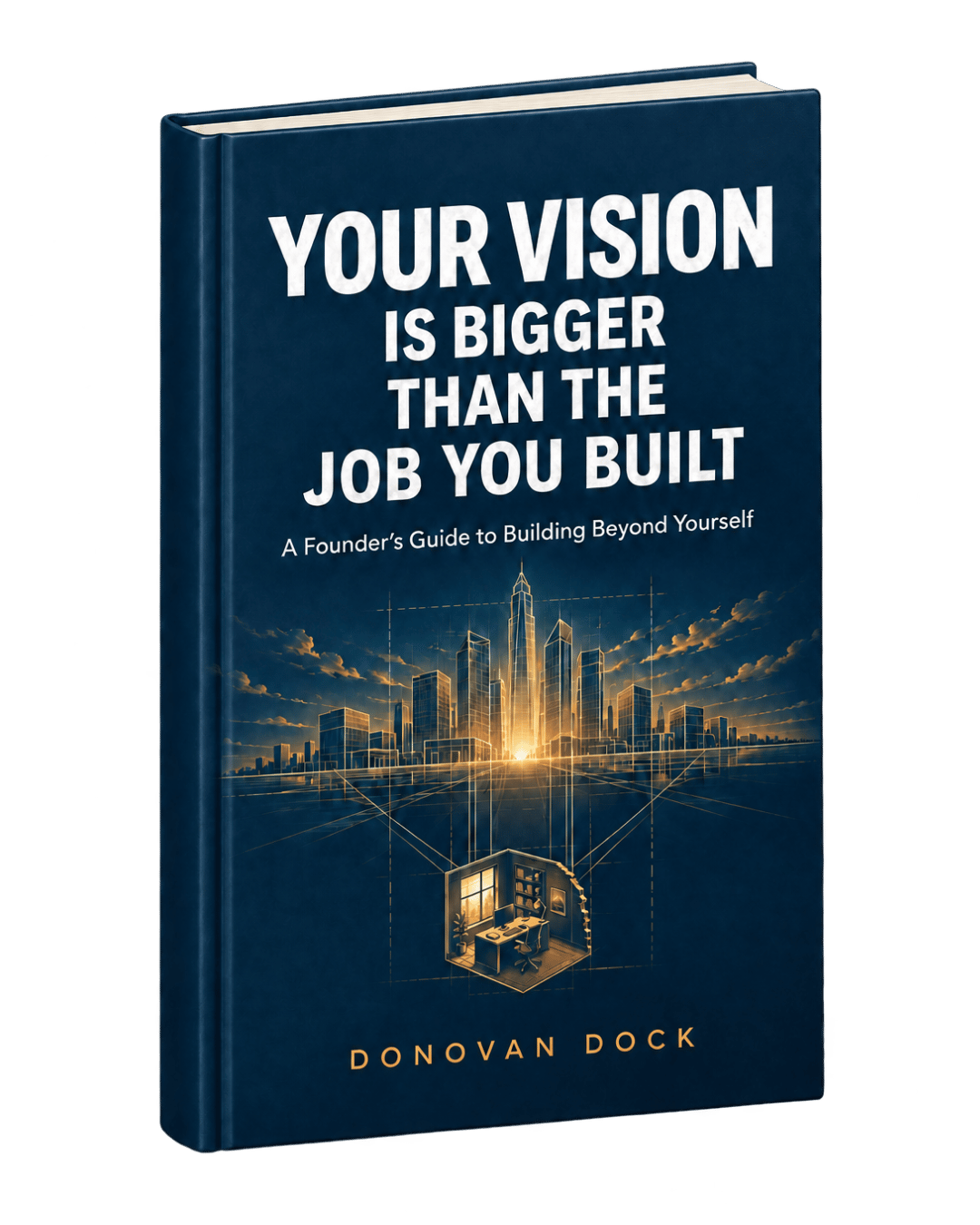
In Your Vision Is Bigger Than the Job You Built: A Founder’s Guide to Building Beyond Yourself, Donovan Dock helps scaling founders confront the structure keeping them trapped. Drawing on his experience in financial planning, brokerage ownership, and business coaching, Dock connects biblical stewardship with practical execution. He shows how working harder can leave the real bottleneck untouched.
You’ll calculate your true hourly rate, price the roles you keep filling, and discover what doing everything yourself costs. Then you’ll identify your “pearl”—your business’s distinctive contribution—and give it protected space in your calendar.
A three-to-five-year Vision Blueprint, annual milestones, and focused ninety-day sprints provide the structure for moving forward. You’ll finish with a clear first move: one task to hand off within forty-eight hours and a weekly rhythm that supports your vision.
You’ve proven you can work hard. Now build a business with room for the vision that started it all.
The Blueprint Nobody Wrote
"Where there is no vision, the people perish: but he that keepeth the law, happy is he." — Proverbs 29:18
We hear the first part of that verse quoted constantly, right? Cast vision. Dream big. But the scripture doesn't stop at vision. It links the vision directly to keeping the law—the order, the discipline, the written blueprint that actually makes the vision sustainable.
Go back to the beginning of your business. Maybe it was a garage. Maybe it was the kitchen table after the kids went to bed, a laptop open next to a cold cup of coffee. Wherever it was, you remember the feeling. You were finally going to build something that was yours.
You pictured the freedom first, didn't you? Mornings you controlled. Clients you actually wanted to work with, and the courage to say no to the ones you didn't. You pictured the life this thing was going to pay for: the house, the trips, the time with your family, the giving you always wanted to do and never had room for. That was the vision. It was real, and it was good.
Now let me ask you the harder question. When you first started, what did you picture a normal Tuesday looking like? What does a normal Tuesday actually look like right now?
When I ask founders that, most of them end up describing a job, and a demanding one at that. Every decision waits on them. Name three decisions this week that couldn't happen until you made them. What's one critical piece of the business that exists only in your head? The week runs past sixty hours, and the weekend isn't really a weekend—it's just the part of the week when the phone rings less. You own the business on paper, but the business owns your calendar.
So what happened? Somewhere between the vision and the building, something went sideways. That's what this chapter is about.
You're Buried, and That's Fixable
Before we go one step further, I want to clear something off the table, because I know what a lot of you are carrying. You've been told, or you've told yourself, that if you just pushed harder, got up earlier, hustled a little more, it would all come together. And when it doesn't, you start wondering if something's wrong with you.
Here’s what I tell every founder who sits across from me: “You’re not lazy. You’re buried.”
Being buried by day-to-day demands is an engineering challenge, a breakdown in operating design. That is a structure problem, and structure is something we can intentionally diagnose, design, and build.
I’m not here to scold you into working harder. You’ve been working hard enough. I’m here to help you name what is actually happening in the business and put real systems under your ambition.
The Core Idea
Here it is, as plain as I can say it: a vision without a written structure turns into a job.
By written structure, I mean practical clarity on paper: explicit decision rights so your team knows who decides what, defined responsibilities so roles do not overlap or fall through the cracks, repeatable processes that let work happen consistently without you, and unambiguous priorities so everyone knows what comes first on a busy Tuesday.
When the whole business lives in your head, the business can only move as fast as you can think, decide, and act. Who handles that client? You. What do we charge for this? Ask the owner. Where's that file, how does that process work, what happens when this breaks? Go find the founder. You've become the bottleneck, and every road in the company runs through one door. That door is you.
Consider how a corporate organization works. In a big company, there's a book. Everybody has a job, everybody knows their station, and when you get promoted you step into a structure somebody else already wrote. When you start a small business, there's no book. You have to write it yourself. And most founders never do, because they're too busy doing everything the book would have handed off.
Why You Can't See It From Inside
This trap is sneaky, and once you see it, you can't unsee it.
Working inside your business feels like progress. It leaves proof behind. You answered forty emails today. You shipped the deliverable. You got the proposal out the door. You can point at all of it and say, "Look what I did." There's a scoreboard, and the score keeps going up.
Working on your business does not feel that way, at least at first. When you sit down to design how decisions get made without you, or who owns which part of the operation, you don't walk away with a pile of finished tasks. You walk away with decisions. Nothing you can hold up. Nothing that shows.
So what do we do? We keep choosing the work that shows. Every single day, we pick the email over the blueprint, the client call over the org chart, the fire over the floor plan. It feels responsible, and it feels like winning. And the structure never gets written.
Busy and building are two completely different things. You can be exceptional at your craft and still pour your energy into an operating model that holds you hostage. Better structure cannot guarantee an easy road, but it provides the solid foundation required to give your business room to breathe and mature.
The Half of the Verse Everybody Skips
As noted earlier, everybody loves that first half of Proverbs 29:18. You'll see it on motivational posters and hear it at leadership seminars. Cast vision. Dream big. And that's true—vision matters. Without it, people perish.
But look at the second half, because that's the part nobody wants to put into a motivational speech. He that keepeth the law, happy is he. Vision is only half of the verse. The other half is the law, the written order that keeps the vision alive once the excitement wears off. It's so attractive to dream big. It's a lot less attractive to sit down and write the structure, embrace the discipline, and keep the process. But that's where the happiness is.
Most founders I meet have extraordinary vision, deep commitment, and heart for their work. What they lack is the written framework to support it. That is what this book helps you build.
Who's Talking to You
Let me tell you a little about who I am so you know where this is coming from. I spent years in the financial-planning world and climbed into senior leadership. I walked away from that world twice: once when I turned down an executive offer for vice president of national sales, and once when I had a successful exit from my own brokerage. I've lived on both sides—inside the structure where everybody knows their hat, and out in small business where you have to build every bit of it from scratch.
I will share more of that story in the next chapter, including a transmission shop that taught me about real operational leverage. For now, understand that this is not cold theory. It comes from having lived through the bottleneck myself and watching other founders do the hard, honest work to systematically climb out.
The Road Ahead
Here is where this book will take you: first, an honest diagnosis of where your operation stands; second, the cold math behind the sixty-hour workweek and the tasks eating your time; and third, the practical structure needed so your business can deliver results without requiring you at the center of every task.
Before You Turn the Page
When you started, what did you picture a normal Tuesday looking like?
What does a normal Tuesday actually look like right now?
What's one piece of the business that exists only in your head?
Here is the truth to carry into the next chapter: a business without a written blueprint is a house its owner has to hold up with their own hands.
The Ladder and the Transmission Bay
"Through wisdom is a house built; and by understanding it is established." (Proverbs 24:3) We closed the last chapter with a house—a house its owner has to hold up with his own hands. I want to open this one by pointing to the verse that shows us how a house gets built in the first place. Solomon doesn't say a house is built by hustle. He doesn'